

Have you ever wondered what it’s like to see the social world through the eyes of a high-functioning autistic person?
Or- do you see through those eyes yourself?
If so: this one’s for you.
Today I’m happy to give you a sneak-peek excerpt from Jeffrey-Michael Kane’s new book, “QUIET BRILLIANCE: What Employers Miss About Neurodivergent Talent — And How to Finally See It”. I hope you enjoy!
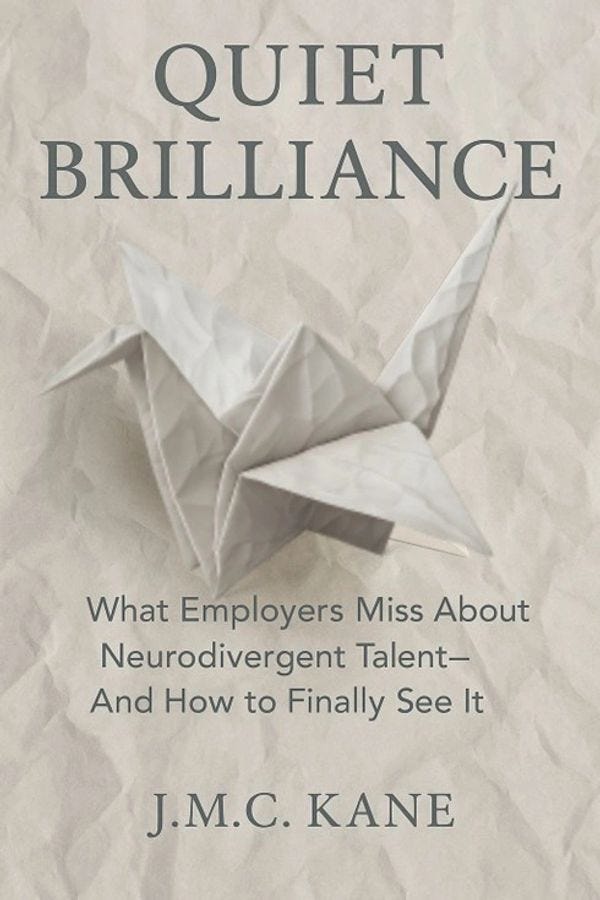
“When Susan Cain wrote Quiet, she gave voice to millions who’d felt overlooked in a culture that mistakes volume for value. But what about those of us who are quiet not by temperament, but by neurological design?
As someone with Asperger’s, I’ve spent decades navigating workplaces that equate social fluency with professional competence—where “culture fit” often means performing a version of connection that drains rather than energizes. In my upcoming book, I explore what authentic workplace inclusion looks like when we expand our definition of how people contribute, connect, and lead.
The following excerpt examines those everyday workplace moments—the hallway encounters, the mandatory team-building, the unspoken social tests—that can make brilliant contributors feel like outsiders. It’s not about changing who we are; it’s about creating space for different ways of belonging.
From Chapter 3: “Social Situations Are Not My Strength — and That’s Okay“.
Section 3.1: The Discomfort of the Unscripted
Some of the most difficult moments in my workday aren’t in front of a screen — they’re in doorways. Hallways. Elevators. Kitchens. Anywhere informal conversation is expected to happen without structure. It’s not that I’m shy. It’s that I don’t know what to do with unscripted interaction — especially when it arrives layered with social expectation.
Small talk moves too fast for me. Not in speed, but in shape. The rules shift mid-sentence. I never know whether someone is genuinely asking about my weekend or just using the phrase as a greeting. I don’t always know how to respond — not because I’m disinterested, but because I don’t want to get it wrong. And in trying not to offend, I often hesitate, pause, or give a response that sounds clipped or flat. That hesitation is frequently read as aloofness or awkwardness. But what you’re seeing isn’t rudeness. It’s restraint.
Unstructured social interaction requires me to read tone, body language, eye contact, timing — and interpret all of it in real time while figuring out if I’m even in the conversation or still hovering near it. It’s like being asked to dance to music I can’t hear while everyone else seems to know the steps by heart.
I don’t avoid these moments because I dislike people. I avoid them because I dislike feeling lost in plain sight.
If I seem quiet in a group setting, it’s not detachment — it’s restraint. I’m trying to avoid missteps, not avoid people.
Section 3.3: What Forced Fun Feels Like
There’s a particular kind of dread that sets in when the calendar invite says “mandatory team-building.” Sometimes it’s a bowling night. Sometimes an off-site retreat. Sometimes it’s a Zoom trivia hour at 4:30 p.m. on a Friday. What it almost never feels like — for someone like me — is connection. It feels like a test I didn’t ask to take, for a subject I never studied.
These events are rarely malicious. They’re often planned with good intentions. But they rest on a faulty assumption: that what brings people closer is shared informality. And for me, that’s where the trouble begins. I can deliver a detailed briefing to a federal client without blinking, but I don’t know what to do with myself in a room full of unstructured small talk and mandatory cheer. There’s no script. No timing. No graceful exit. Just the rising hum of conversations that don’t wait for me to catch up — and the silent calculation of how much longer I need to stay before it’s safe to leave.
And it’s not just discomfort. It’s energy. Social performance — especially in settings without structure — drains me at a cellular level. I’m not recharging through it. I’m depleting. The smiles take effort. The mingling takes effort. The pretending to enjoy what’s actually overwhelming takes effort. I don’t come back from these events feeling included. I come back needing to recover.
The moment connection becomes compulsory, it stops being connection. It becomes theater. And I’ve spent enough of my life pretending to belong.
Section 3.6: What You Can Do
Don’t force participation in happy hours or team-building games
Make social events truly optional and low-pressure. Let people opt in because they want to, not because it’s a hidden test of culture fit.
Offer options for one-on-one check-ins instead of large group meetings
Private, structured conversations reduce social noise and build trust more effectively than chaotic group settings.
Interpret silence as processing — not disinterest
A quiet person may be thinking carefully before responding. Give time, and you’ll get thoughtfulness instead of filler.
Create space for contribution in writing or asynchronously
Some of our best thinking happens off the cuff — but not in real time. Make room for reflection as a valid form of contribution.
Recognize that social restraint is not the same as disconnection
Just because I don’t speak often doesn’t mean I don’t care. I connect through consistency, not charisma.
Inclusion doesn’t mean asking everyone to act the same. It means making room for different ways of connecting, contributing, and caring. You don’t have to change your entire culture — just widen the doorway. Many of us are already standing outside, quietly hoping to be let in.
…
If these workplace moments feel familiar—whether you’re neurodivergent or simply someone who’s felt misunderstood in professional settings—you’re not alone. Quiet Brilliance explores how we can build workplaces that value authentic contribution over social performance, where different types of minds aren’t just accommodated, but celebrated for the unique perspectives they bring.
Because the future belongs to organizations that can see brilliance in all its forms—even the quiet ones.”
-
OK, this is Susan writing again. I hope you enjoyed this piece as much as I did, and am very curious to know:
*Do you consider yourself either introverted or autistic?
*If the former, were you struck by any overlaps in your experience of what it’s like to participate in team-building exercises, etc.?
*If the latter, did you relate to this piece? Do you have any other thoughts to add?
We always love to hear from you.
I can relate to some of this as a highly sensitive person (HSP), also introverted. Much of the discomfort described sounds familiar, though for different reasons. In researching the HSP trait for my hybrid memoir (to be published in 2027), I learned that the high sensitivity trait is, in some scientific circles, considered to be a neurodivergent trait. This understanding is new and not agreed with across the board, but it makes sense to me.
I'm beginning to wonder if there's really any such thing as a "normal" or "normally functioning" brain. Such a complex and little-understood organ surely has many wild and wonderful ways of expressing itself.
I really appreciate these words describing what I’ve seen at the office. I’ve been the one putting on the team building activities trying to get people connected. This is really eye opening. I need to read this, I have a lot to learn.