


“Mattering offers a deeper, almost intuitive framework for understanding what is assailing our kids and points us to where best parental energies can be spent if we want to protect our kids from this excessive pressure.”
So says Jennifer Wallace, the founder of The Mattering Institute, whose mission is to create cultures of mattering in workplaces and communities, and co-founder of The Mattering Movement, a nonprofit organization dedicated to creating cultures of mattering in schools.
In her brand-new book, MATTERING: The Secret to a Life of Deep Connection and Purpose, Wallace shares what we can do to combat the pandemic of loneliness and despair that are harming our youth, and how we can combat today’s widespread mattering deficit.
And she has graciously offered to share an excerpt from her book with us today - focusing on the tools and skills for building meaningful community, buffering against stress and anxiety, and making a positive impact on the world.
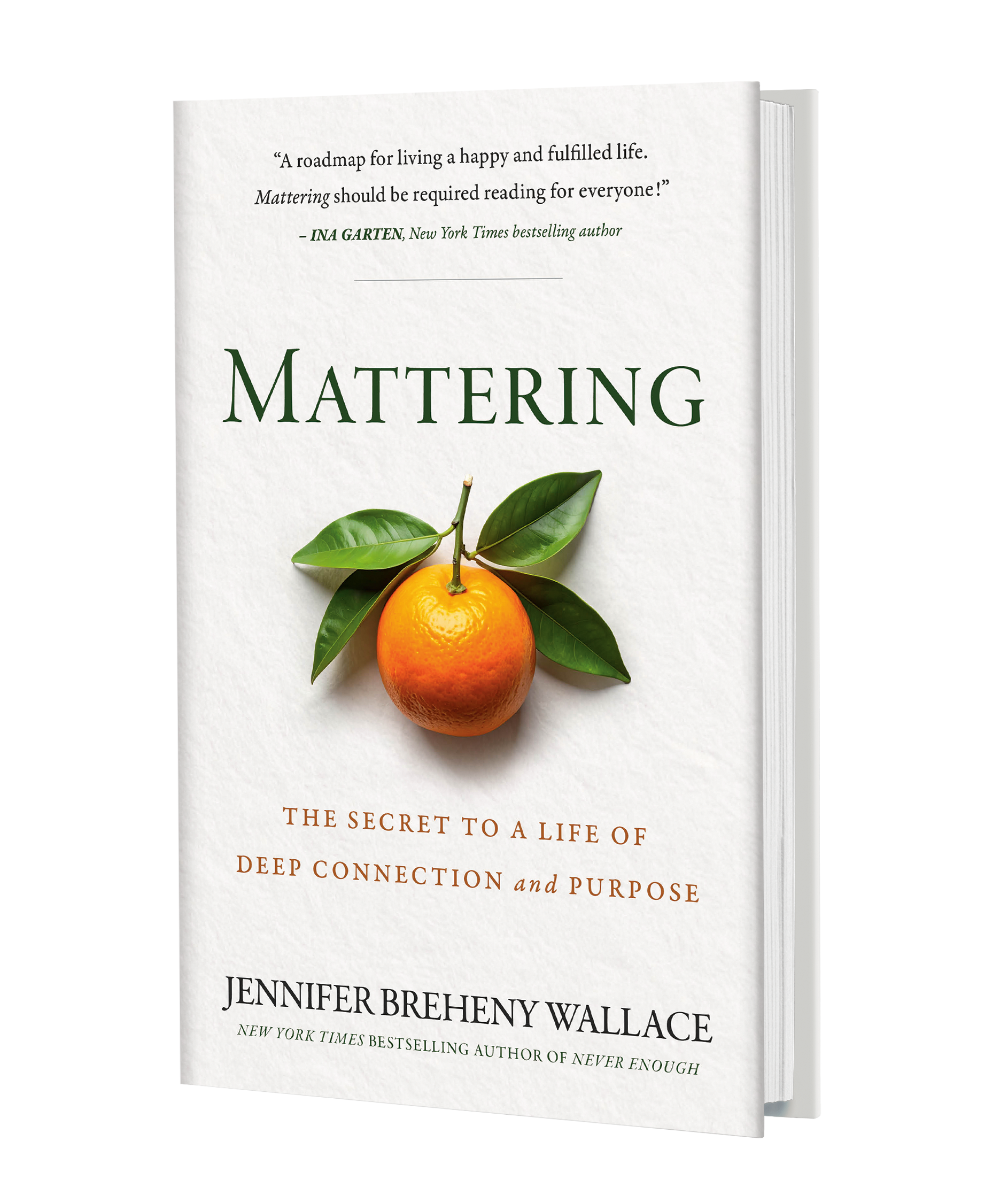
Here’s Jennifer:
“When the Rug Gets Pulled: Coping With Life’s Transitions
In her best friend’s living room, Nancy Schlossberg sat with her hands wrapped around a warm mug of coffee. After twenty years of friendship, Sue’s living room was familiar ground, the kind of place where Nancy didn’t have to pretend. “My life looks perfect from the outside,” Nancy said in a low voice. “So why do I feel so miserable?”
They’d been talking about how Nancy’s recent relocation back to Washington, D.C. had thrown her off, how much she missed the structure and routine of her old life in Michigan. After spending ten years there, her husband’s work brought them back to Washington, D.C. It felt like the right move. Nancy had landed a prestigious position at the American Council on Education. Her best friend lived across town. She loved Washington, D.C. Every box was checked. So why was she feeling so lost?
Will I matter again?
What Nancy was experiencing has a name: a collapse of what researchers call mattering. Mattering is the sense that we are valued by others and that we have value to contribute to the world. At its core, mattering answers our most fundamental human questions: Am I valued? Does my presence make a difference? This need is deeply rooted in our evolutionary past. For early humans, being valued by the group meant safety and survival; being overlooked meant risk. That wiring remains.
When we experience a life transition, such as retirement, an empty nest, losing a job, grieving a loved one, or moving to a new city, it can rattle our sense of mattering. It can feel like our previous identity — our understanding of how we add value and to whom, and who values us and why — disappears overnight. But mattering doesn’t just diagnose the problem — it offers the solution.
Mattering is highly actionable and built from specific ingredients that are captured by the acronym SAID: feeling significant (seen and essential), appreciated (valued for who you are and what you contribute), invested in (supported and cared for), and depended on (needed by others). Strengthening these dimensions can expand our “mattering span,” helping us feel grounded, useful, and connected at any stage of life.
Conduct Me-Search
When researchers decide to pursue a question that holds personal relevance, one that grows out of their own struggles or curiosities, it’s somewhat playfully known in academic circles as “me-search.” Me-search is the social psychologist who investigates loneliness after grappling with it herself in early adulthood, or the developmental researcher who studies resilience in children because he grew up in the foster care system. Rather than a mark against scientific rigor, me-search often leads to more empathetic and nuanced questions, driven by an insider’s understanding.
When facing a shaky life transition, me-search can help you find a path forward. Maybe you turn to books, articles, or research studies related to your experience. Maybe you invite someone who has thrived after a similar transition to tell you their story over coffee. Maybe you seek out workshops and talks to gain practical knowledge. For Nancy, the most transformative knowledge came from reaching out directly to people who had similar experiences. In fact, in her interviews, she found that those who coped most effectively often did just this—sought out real-life examples to illuminate their next steps.
The great thing about me-search is that it does more than give us strategies for coping. It is also a deeply relational act that strengthens our ties. When we reach out to learn how someone else has navigated a transition, we send a message that their experience matters to us and that we trust their perspective. When we ask others for guidance, we affirm that our role models and their hard-won experience have value. This creates an upward spiral of interdependent mattering, where both seeker and sharer feel more connected, valued, and significant.
The act of me-search also empowers us to approach transition with curiosity. By turning outward, asking questions, seeking stories, and looking for roadmaps in the lives of others, we shift our perspective from fear of the unknown to an interest in what’s possible. Curiosity can help us move beyond our disorientation and consider our next season as something of an adventure.
Harness the Power of Invitation
When Catherine moved from New Jersey to Florida after her kids left for college, she planned her social relocation as carefully as she planned the logistics of the relocation itself. Back home, Catherine had always been the friend who brought people together, planned moms’ nights out, and routinely checked in on friends. Over the years, these friendships had carried her through job changes and the loss of her mother. She had seen how a simple invitation—a coffee, a walk, a conversation—could pull people out of loneliness and reinforce the important place we fill in others’ lives. So when she and her husband moved to Florida, she made a resolution: she would say “yes” to every invitation that came her way, at least for the first few weeks. No overthinking, no excuses—just yes.
Catherine started by joining a local Facebook group. A few days after arriving, she took a chance and went out to dinner with a few of the group’s members. There, a woman casually invited Catherine to her Super Bowl party that weekend. “Of course, I said yes—my only word to an invite,” Catherine told me. That woman would later become one of Catherine’s closest friends. Little by little, one invitation at a time—golf outings, dinner plans, book club gatherings—Catherine’s new community started to feel like home. And it was all because of her blanket decision to say “yes.”
Saying “yes” can feel surprisingly hard. We might tell ourselves we’re not ready, that we’ll focus on meeting new people once we’ve got our life in order. Or maybe we worry we won’t fit in or that we have nothing to offer. But one way to shift our thinking is to remember that saying “yes” isn’t just for us; it’s for the other person, too. When someone extends an invitation, they’re taking a small risk. They’re reaching out, hoping for connection, and wondering if we’ll meet them halfway. By saying “yes,” we’re accepting that bid, letting them know they matter, too.
Sarah came to understand this firsthand after a divorce at age 45. She knew the transition back to single life was going to be rough. “How exactly do you function as a single person in a couples’ world?” she recalled thinking. Often, she felt like an awkward third wheel when socializing with her couple friends. When the check came at dinner and her friends wouldn’t allow her to split it, or when the conversation turned to topics like romantic weekends away, Sarah would shrink inside. Instead of feeding her mattering, these dinners made her feel out of place. Over time, she felt so uncomfortable that she stopped accepting their invitations. During weekends when she had the kids, her nights would be spent chauffeuring them around, and when her husband had the kids, she’d lock herself in her house, drinking more wine than she liked to admit. Her sense of mattering “shriveled up,” as she put it.
Eventually, Sarah and her therapist uncovered the real cause of her retreat—a secret fear that her friends were judging, or worse, pitying her. Over time, they developed a strategy focused on reframing her mindset: invitations were not just about her; they were about both people in the relationship. Every “yes” was an act of giving and a way of helping others feel seen and valued.
Often, we think that saying “yes” means we have to have our act together. Researchers call this the Beautiful Mess Effect—our tendency to overestimate how harshly others will judge us when we reveal a weakness or failure while underestimating how much they will appreciate our openness. Studies show that while we may see our vulnerability as a flaw, others tend to see it as a strength and a display of warmth, evidence that we are trustworthy. The very thing we fear might push people away is often what draws them closer. Think of it this way: Have you ever tried to tape something to a slick, shiny surface? It doesn’t stick for very long. It’s the rough part, the messy part, that allows for the stickiness to take hold. In the same way, it’s those imperfect parts of ourselves that create paths to true connection by giving others something real to hold onto.
Who are the people in your life you can say “yes” to? How can you accept an invitation you might normally turn down or extend one to someone who might be waiting for it? Perhaps to start, you might set a goal of saying “yes” or offering an invitation twice in a week. That “yes” helps you when you’re feeling lonely, when you’re unsure if you matter. And it helps others, too, letting them know that the connection with them is worth it.
Here’s the wonderful truth: every time we reinforce someone else’s worth, we’re reminded that we, too, are needed, valued, and capable of making a difference. In reminding others that they matter, we are reminded just how much we are, too.”
From MATTERING: The Secret to a Life of Deep Connection and Purpose by Jennifer Breheny Wallace, published on January 27th, 2026, by Portfolio, an imprint of Penguin Publishing Group, a division of Penguin Random House, LLC. Copyright © 2026 by Jennifer Breheny Wallace.
*
I hope you enjoyed this excerpt from Jennifer Wallace!
Would you like to share with us:
*When in your life have you felt that you truly mattered?
*Who in your life consistently makes you feel that you matter — and how do they do this?
*What external measures (money, titles, likes, productivity, grades) most influence your self worth?
*When do you feel most seen — and when do you feel invisible?
*In what ways do you tie your own self-worth to productivity, success or approval?
We always love to hear from you!
I have to admit that my question is not whether I will matter again, but whether I will ever matter, or even whether I should crave mattering.
I understand what Jennifer means. After I was ousted by my church, lost most relationships, and what was sold to me as my life's purpose (to gain people for Christ), I could have asked, "Will I ever matter again?"
But my late diagnosis with autism made me realize upon close inspection that I never mattered. I was a tool, fit to support the system. I was used to bringing the dreams of my head pastor into fruition, and was told so straightforwardly ("The way to grow into your own calling is to support another's calling and dreams until you are found worthy and mature"—which I was not, even after 34 years of serving.)
I know it sounds terribly frustrated and pessimistic, but I have so much to give and almost nobody to give it to. I am not depressed, though. I just trust that what I write and say will someday help someone. But that is not where I derive my worth.
I am doubtful that the acronym SAID (feeling significant, appreciated, invested in, and depended on) is the meaning and purpose of an authentic life. For me, it shows too much dependency on two factors: my own desires and others' expectations.
I think that the stories show us ways back into "normality" rather than into personal growth and authenticity. They perpetuate, calcify, and petrify our belief that we only matter when others show us that we matter to them.
I know this is crucially honest and brutally blunt, but also rather abnormal to think. And I know that what I tell you next is merely my experience: The less I crave mattering, the more I matter to others.
Reminds me of viktor Frankels book , Man’s search for meaning .. After 30 plus year in internal medicine I found and especially in my last 10 years with the VA that often the best medicine is simple genuine interest in the person or that person’s story - how often this is missed by us is truly amazing ,the reasons being many , from system failure, a providers own problems, emotional burn out , or people being raised with poor Weltanschauung (worldviews) - which I posit is more common than you might think …. We are spiritual beings at heart whether we know it or not , not just random directionless products of chance molecular collisions…
I’ll end on a lighter note . A patient wore this tee shirt one day
YOU Matter
Unless you multiple yourself by the speed of light squared , then
You Energy ! 🙂