


“Life has a way of thwarting our best-laid plans. Out of nowhere, we’re confronting the end of a relationship, an unexpected diagnosis, the loss of a job, or some other twist of fate. In these moments, it can feel like we’re free-falling into the unknown”….and into an endless cycle of rumination.
So says Maya Shankar, the cognitive scientist, and host of the critically acclaimed podcast A Slight Change of Plans.
In her brand-new book, The Other Side of Change, Shankar teaches how to navigate unwelcome changes.
And she has graciously offered to share an excerpt from the book with us today - focusing on how to avoid the rumination loops that so often come when life throws us trouble.
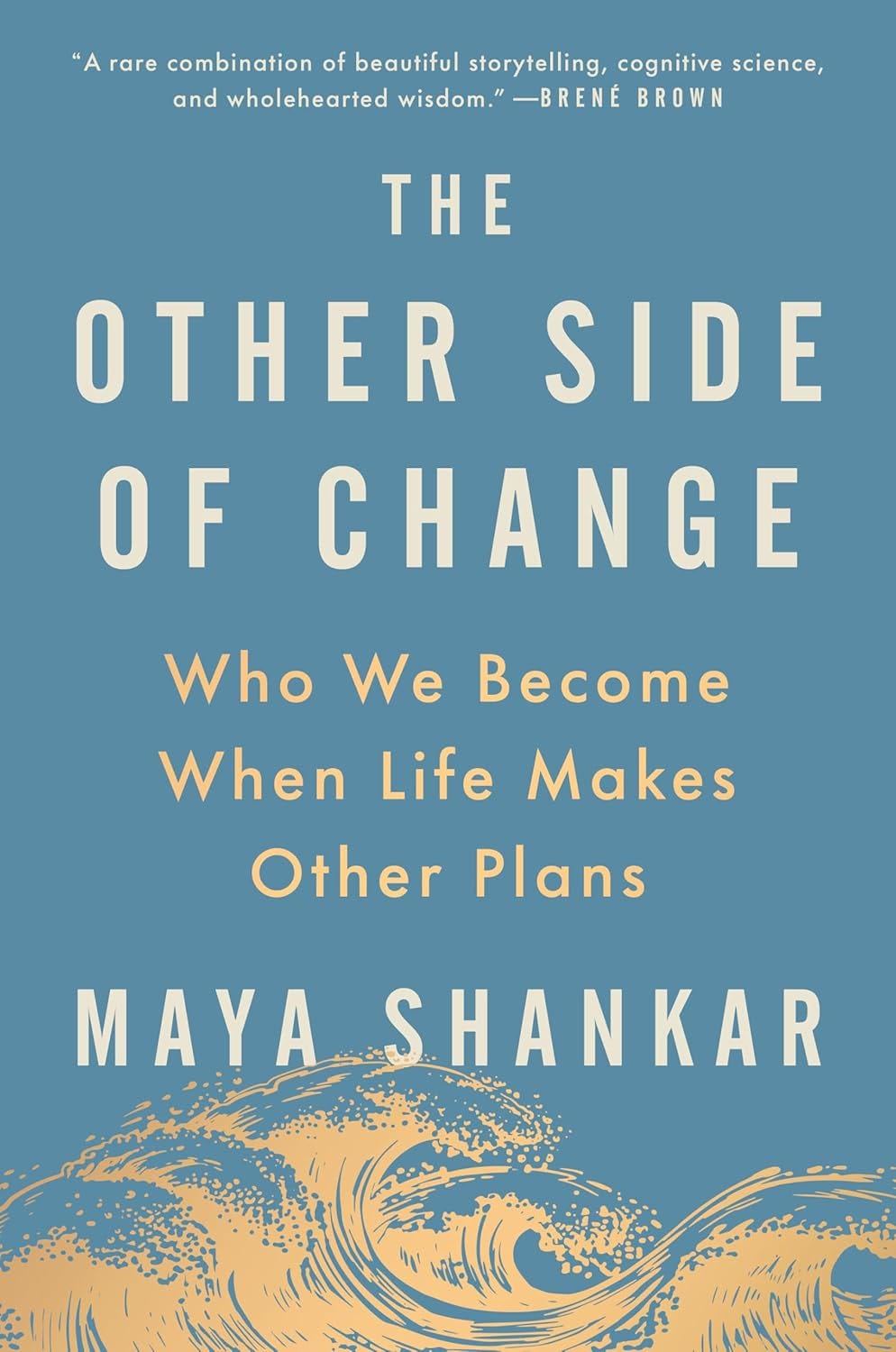
Here’s Maya:
“Most of us know what it’s like to get caught in a negative mental spiral. Any number of things can trigger these unrelenting, suffocating loops, but the catalyst is typically a change in our lives. Our new anxieties, regrets, and uncertainties can take on a life of their own and become a bigger challenge to deal with than the change itself. These thoughts become like mind worms, nestling into our psyches, hijacking our attention, and stoking our biggest fears. What’s wrong with me? How could I not have seen that coming? How could they do that to me? What’s going to happen?
This is known as rumination, and it can involve obsessively rehashing something in the past, grappling with perceived problems in the present, or catastrophizing an imagined future. When we’re in its grip, it can be hard to focus on anything else or to conceive of ever moving past our problem. Rumination is a common symptom of conditions like depression and anxiety, but anyone can fall into its trap from time to time.
Part of the allure of fixating on a particular problem is that analysis and self-reflection often do bear fruit. But when we ruminate, we’re not actually making progress toward a solution: we’re simply cycling through the same negative thoughts over and over again. Each time we engage with our problem, though, we can fall prey to the illusion that we’re on the verge of a breakthrough—that we’re just about to gain some great insight, find closure, or attain some guarantee of security. If I analyze my mistake enough, I’ll avoid repeating the mistake in the future. If I dwell on this failure, I’ll feel like I have paid my penance and can move on. If I catalog all the harms that may affect my family, I’ll be able to keep them safe.
Similar to when we’re in denial or think that our possible selves have been predetermined, rumination puts blinders on us. We are trapped within a narrow understanding of our situation and are unable to see that there are other ways to approach it. We might search only for further evidence that confirms our worries. This can lead us to double down on our convictions, however unfounded they might be.
So, what does it take to break free from these maddening mental spirals? If you’ve ever experienced rumination, you likely know that the brute-force approach of telling yourself to “just stop already” usually makes things worse. What does work, it turns out, is a technique called psychological distancing. As researched by psychologists like Ethan Kross and Ozlem Ayduk, psychological distancing involves creating space between yourself and the thoughts that have taken hold. In other words, since rumination arises from zooming in too closely on a situation, one of the best ways to break free from it is to actively zoom out. This distance allows you to see your situation from new angles, which can release you from rumination’s hamster wheel.
Zooming out involves proactively seeking other points of view or greater context so that you can approach your problems more constructively. Just as there are different ways you can fall into ruminative loops, there are also many ways you can spring out from them.
When a change occurs in our lives, our instinct may be to resist the uncertainty it brings and to try to resolve it. Often, this intolerance of uncertainty is what gives rise to mental spirals—our brains search in earnest for answers, despite the fact that there are none to be found. Rumination, in other words, can be an expression of a desire to assert control in situations where we simply have less of it than we’d like. The more we can strive to exist comfortably in life’s gray spaces, the less likely it is that rumination will take hold.
The specific topic our rumination latches on to will vary throughout our lives. Each time we’re stuck in a new loop, its novelty can give it a kind of power. Even if we’ve triumphed over previous bouts of rumination, it can feel like this new issue is somehow different and will resist all intervention. That’s the devilish side of rumination: our brains will fool us into thinking that the topic we’re currently perseverating over is the most threatening, most pressing issue we’ve faced, and that we have no defenses against this new foe.
This is why it can be useful to assemble a diverse anti-rumination tool kit. Different tools will work in different situations, and what worked last time may not work this time. In addition to the zooming-out techniques of cognitive reappraisal, mental time travel, and awe, another tool you can add to your kit is affect labeling. This involves taking a step back and trying to identify what negative emotions you’re experiencing as a result of your rumination. Research shows that giving a negative feeling a specific label (for example, “frustration,” “despair,” or “envy”) can reduce its intensity. Naming it fosters psychological distance by shifting your perception away from “being” the emotion to simply “having” the emotion.
Another tool for zooming out is visual self-distancing, in which you mentally view your situation from a “fly on the wall” perspective. For example, you might revisit that tense conversation with your coworker from earlier in the day, but this time you try to process it not from a first-person perspective but instead as an impartial observer. This approach has been shown to decrease emotional reactivity and to lower the frequency of intrusive thoughts.
A related strategy is distanced self-talk, which you can practice in one of two ways. The first way, rooted in self-compassion research by the psychologist Kristin Neff, is to coach yourself through your situation as you might coach a friend: this can limit your self-berating and keep you focused on generating constructive advice. The second way is to refer to yourself in the third person—using your name—or in the second person, when guiding yourself through a problem. (For instance, “Maya, you need to get a grip!” rather than “I need to get a grip!”) This tweak in framing has proved to be a powerful antidote to rumination in both high- and low-stress situations, for both past and future events, and across a wide range of negative emotions.
And finally, it’s worth noting that engaging in activities that distract you from your negative emotions is not only okay but can be beneficial. One narrative that has become pervasive, particularly in Western conversations around wellness, is that the only healthy way to move on from a bad experience is to approach it — to fully confront, express, and process your negative emotions. Otherwise, you risk having those emotions resurface in the future with even greater force.
But recent research on resilience reveals a more complex story, in which individual differences play a big role in determining what makes for a healthy response in any given circumstance. The upshot of this research is that if directly and persistently confronting your negative emotions is working for you, stay the course. But if you’re not gravitating toward that method and are doing fine — or if some combination of both approaching and avoiding your negative emotions is your sweet spot — there’s no need to feel guilty or to fear that you will pay for it later. As the psychologist Ethan Kross writes, “If something doesn’t keep cropping up, there’s a good chance you’re not harboring some invisible wound that will fester and ruin your life decades down the road.”
Excerpted from THE OTHER SIDE OF CHANGE: Who We Become When Life Makes Other Plans by Maya Shankar. Copyright © 2026 by Maya Shankar. All rights reserved. No part of this excerpt may be reproduced or reprinted without permission in writing from the publisher.
*
I hope you enjoyed this excerpt from Maya Shankar!
Would you like to share with us:
*What topics have recently caught you in a rumination loop?
*What unwelcome changes have recently entered your life?
*Whether any of the above techniques resonated with you?
We always love to hear from you!
This is wonderful and I can relate to so much of what is written. As a highly sensitive individual, I have experienced my fair share of rumination as well as anxiety!
My daughter is currently a senior in high school and the process of looking for colleges has definitely triggered the rumination loop for me. Searching for ‘all the things that can go wrong’. The college search process has brought in lots of joy too, but worry and fear has been ever present as I navigate emotions of becoming an empty nester.
Please know I reside in Minneapolis with my husband, daughter and greyhound - need I say more. I am doing lots of self-care at the moment to bring in as much grounding and to stay rooted in my body as much as humanly possible. These are unprecedented times in my city and our country!!!
I personally find Epsom salt baths, meditation and walks outside in nature with my dog give me space to see my thoughts patterns more objectively - making the rumination spiral less severe and steep.
Sending each and every one of you care and wishing you ease and grace on your life journey.
A special thanks to you Susan for the thoughtful, intelligent and affirming content you continue to provide here within The Quiet Life.
My ability to coach myself out of ruminations was part of the reason I became a coach. The start point was the key. “Now, David, let’s sit and write down what the issue is here.” Keep writing until the imagined outcome becomes clear. Then you can start imagining solutions.