


Two weeks ago, I took a fascinating course on Freud and Jung’s differing views of the psychology of religion. Three hours went by without my ever feeling the urge to check my phone. To share the whole thing would take thousands of words, but for today I’d like to share some highlights of these two great psychologists’ contrasting views of religion.
It will be interesting to see whether you find yourself in both their views, or decidedly on one side or the other.
This is an urgent question because the answer shapes how we live our lives personally, how we find psychological health, and how we make moral progress as a species.
(This is a pretty meaty Kindred Letter - it took me ages to put it together! I know it’s a busy weekday, so you might want to hold on to this one, and read/re-read it when you have time.)
*
FIRST, WE’LL TALK ABOUT FREUD (1856-1939) AND “THE OCEANIC FEELING”
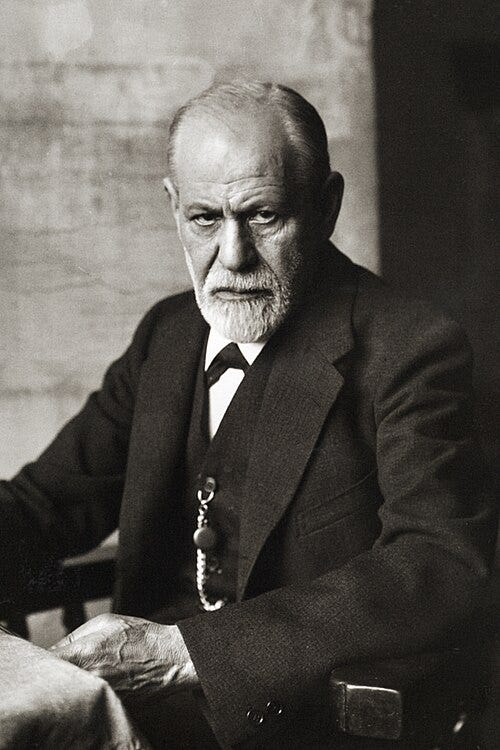
In 1927, a man named Romain Rolland sent a letter to Sigmund Freud.
Rolland had just received a copy of Freud’s latest book, and he suggested that in future writings Freud should consider “the oceanic feeling”:
But I would have liked to see you doing an analysis of spontaneous religious sentiment or, more exactly, of religious feeling which is [...] the simple and direct fact of the feeling of the eternal (which can very well not be eternal, but simply without perceptible limits, and like oceanic).
— Letter from Rolland to Freud, December 5, 1927
Rolland described the “oceanic feeling” as “a sensation of ‘eternity,’ a feeling as of something limitless, unbounded," “a feeling of an indissoluble bond, of being one with the external world as a whole.” He believed that this feeling is the source of all the world’s religions, and indeed that you could call yourself “religious” based on this feeling alone, even if you’d renounced all other aspects of faith, dogma and belief.
Have you ever had this experience? It comes to many of us via music, prayer, nature, meditation, psychedelics, love, or just out of the blue. For some people the experience is mild and infrequent; for others it’s dramatic and overpowering and leaves them with the question of — as my friend, the Johns Hopkins professor David Yaden put it — “WTF just happened to me?”
For others — including Freud — it never happens at all.
(For me, as I’ve mentioned before, it comes reliably via music. My last experience of it was last week when I listened to Idan Raichel singing Mi’Ma’amakim (“Out of the Depths”).
The “oceanic feeling” has many other names. William James called it the “mystical experience”; for Rudolf Otto, it was the “Mysterium Tremendum” or the “numinous.” Abraham Maslow called it a “peak experience,” and for Jung it was “the Self,” or a numinous experience of the archetype of the divine.
One of my own favorite descriptions of the mystical experience comes from the contemporary British philosopher Simon Critchley, who describes it as “the cultivation of practices which allow you to free yourself of your standard habits, your usual fancies and imaginings and see what is there and stand with what is there ecstatically.”
But what do these experiences mean?
Are they glimpses of something profound, or are they psychological illusions?
Are they good for the soul and the polity — or are they dangerous, destructive and divisive?
If they’re good and healthy for the soul - how can we have them more often?